Introduction
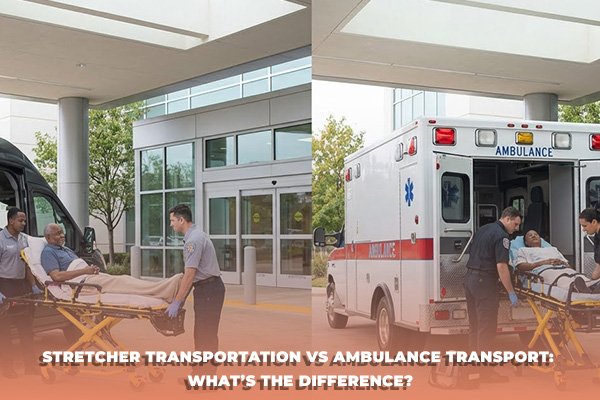
When patients need to travel lying down, families often assume an ambulance is required. In reality, stretcher transportation and ambulance transport serve very different purposes.
Understanding the difference helps families in Omaha choose the safest, most appropriate option without unnecessary expense or urgency.
What Ambulance Transport Is Designed For
Ambulance transport is intended for:
- Emergency situations
- Unstable medical conditions
- Continuous medical monitoring
- Life-saving interventions
Ambulances are staffed with EMTs or paramedics and equipped for emergencies—not routine discharges.
What Stretcher Transportation Is Designed For
Stretcher transportation is part of Non-Emergency Medical Transportation (NEMT services) and is designed for patients who:
- Are medically stable
- Must remain lying down
- Do not need emergency monitoring
It focuses on comfort, positioning, and safety—not emergency care.
Key Differences at a Glance
Feature Comparison
Key Differences Between the Two
| Feature | Ambulatory Transport | Wheelchair Transport |
| Walking required | Yes | No |
| Wheelchair securement | No | Yes |
| Vehicle equipment | Standard | Medical-grade |
| Fall risk | Higher | Lower |
When Stretcher Transportation Is the Better Choice
Stretcher transportation is ideal for:
- Hospital discharge
- Facility transfers
- Post-surgical recovery
- Stable patients with mobility restrictions
Final Thoughts
Ambulances save lives—but stretcher transportation supports recovery. Choosing the right service ensures safety without unnecessary emergency intervention.